





Maximum Power Starts With the Right Kind of Capability in the 2025 Chevy Silverado 3500 HD
The 2025 Chevy Silverado 3500 HD is often described in terms of maximum power, but for most buyers, power is not the decision. Capability is. The reason drivers consider a heavy-duty truck like the 2025 Chevy Silverado 3500 HD is because they need it to perform under load, whether that means towing a large trailer, carrying equipment, or handling consistent work demands. Understanding how that capability is built and how it should be evaluated is what allows you to decide if this truck fits your needs or if a different configuration would be more practical.
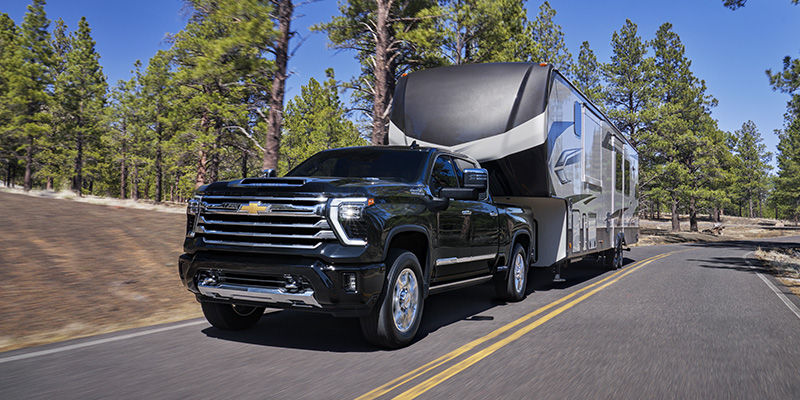
Towing capacity only matters when it aligns with payload and setup
When shoppers look at the 2025 Chevy Silverado 3500 HD, one of the first questions is how much it can tow. Towing capacity is the maximum weight the truck can pull when properly equipped, but that number does not stand alone. It works alongside payload, which is the amount of weight the truck can carry in the bed and cab, including passengers and trailer tongue weight.
The important distinction is that payload often becomes the limiting factor before towing capacity does. A fifth wheel or gooseneck trailer places weight directly over the truck, which means the truck must support that load in addition to pulling it. That is why the 2025 Chevy Silverado 3500 HD is designed with higher payload capability and available dual rear wheels to stabilize and support heavier setups.
When evaluating towing in the 2025 Chevy Silverado 3500 HD, it helps to think in terms of total load, not just what is being pulled:
- Trailer weight determines towing demand
- Hitch type determines how weight is distributed
- Cargo and passengers affect available payload
- Rear axle setup influences stability and capacity
This is where many buyers benefit from stepping back and asking whether their expected load actually requires a 3500 HD or if a lower configuration would handle the job. Matching both towing and payload to your use is what ensures the truck performs the way you expect.
Gas versus Duramax diesel depends on how often you use the capability
A common decision point with the 2025 Chevy Silverado 3500 HD is choosing between the 6.6L gas V8 and the available Duramax 6.6L Turbo-Diesel V8. Both engines provide strong capability, but they are designed for different usage patterns.
The gas V8 delivers consistent performance for drivers who tow occasionally or use the truck for mixed daily driving and work. It offers straightforward operation and can handle moderate loads without requiring the added complexity of a diesel system.
The Duramax diesel changes how the truck behaves under load. Torque is the force that helps move heavy weight, and the diesel engine produces significantly more torque at lower engine speeds. That matters when towing uphill, maintaining speed under load, or managing heavier trailers over longer distances. Paired with the Allison 10-speed automatic transmission, the Duramax helps keep power delivery smooth and controlled when the truck is working at its highest capacity.
The decision comes down to how the truck will actually be used:
- Frequent heavy towing benefits from diesel torque and efficiency under load
- Occasional towing with more daily driving may align better with the gas engine
- Long-distance hauling favors diesel for sustained performance
- Mixed-use ownership often prioritizes simplicity and lower upfront cost
Understanding that difference prevents choosing an engine based on numbers alone and instead aligns the truck with how it will perform in your routine.
When the 2025 Chevy Silverado 3500 HD makes more sense than the 2500 HD
Another key decision is whether the 2025 Chevy Silverado 3500 HD is necessary compared to the Silverado 2500 HD. The difference is not simply more power. It is about how much weight the truck is built to support and how stable it remains when carrying or towing that weight.
The 3500 HD is designed for higher payload and maximum-capacity towing, especially when configured with dual rear wheels. This makes it the better choice for drivers who plan to tow large fifth-wheel or gooseneck trailers, carry heavier equipment in the bed, or operate near the upper limits of what a heavy-duty truck is designed to handle.
The 2500 HD, on the other hand, can meet the needs of many drivers who require strong towing capability but do not consistently operate at maximum load. It often provides a balance between capability and everyday usability.
The decision point becomes clearer when you evaluate how often the truck will operate under heavy load. If the workload regularly approaches the upper range of towing and payload, the 2025 Chevy Silverado 3500 HD provides the structural capability and stability needed to support it. If not, a lower configuration may provide a more practical ownership experience.
Single rear wheel versus dual rear wheel changes both capability and daily use
Choosing between single rear wheel and dual rear wheel configurations in the 2025 Chevy Silverado 3500 HD directly affects both performance and everyday usability. A dual rear wheel setup increases the contact area at the rear axle, which improves stability when towing large or tall trailers and allows for higher payload and towing capacity.
This added stability becomes important when managing heavier loads or longer trailers, where control and balance are critical. The tradeoff is that a dually truck is wider, which can affect maneuverability, parking, and how easily the truck fits into everyday driving environments.
A single rear wheel configuration is often easier to live with on a daily basis. It provides strong capability while maintaining a more manageable size for driving and parking. For many buyers, the decision comes down to whether maximum capacity and stability are required or whether a balance of capability and usability is more appropriate.
Trailering technology supports control, visibility, and confidence under load
The 2025 Chevy Silverado 3500 HD includes a range of trailering technologies that are designed to support the driver when managing a trailer, especially in situations where visibility and control become more difficult. These systems are most valuable when understood as tools that reduce complexity during towing.
Features such as integrated trailer brake control help regulate braking force between the truck and trailer, which improves stopping stability. Camera systems and available views provide better visibility around and behind the trailer, helping the driver understand positioning when reversing or changing lanes. Trailer-focused alerts like Trailer Side Blind Zone Alert extend awareness beyond the truck itself to include the trailer’s length.
These systems matter because towing changes how a vehicle behaves. Acceleration, braking, and turning all require more awareness and control. The technology in the 2025 Chevy Silverado 3500 HD is designed to support those adjustments so the driver can focus on maintaining stability and positioning rather than compensating for limited visibility or delayed response.
Choosing the right Silverado 3500 HD configuration comes down to how you use it
The 2025 Chevy Silverado 3500 HD is capable of handling some of the most demanding truck workloads available, but the right configuration depends on how that capability will actually be used. Maximum towing numbers, engine output, and advanced technology all play a role, but they only matter when they align with your specific needs.
The most effective way to evaluate this truck is to start with your expected workload and work backward. Consider what you plan to tow, how often you will tow it, how much weight will be carried in the bed, and how the truck will be used when it is not under load. Those factors determine whether you need diesel torque, dual rear wheels, or maximum-capacity towing, or whether a more balanced setup would provide the same results with fewer tradeoffs.
When the configuration matches the workload, the 2025 Chevy Silverado 3500 HD becomes more than a powerful truck. It becomes a tool that performs consistently, supports demanding tasks, and fits into your day-to-day driving without unnecessary compromise.
Connect with us


