




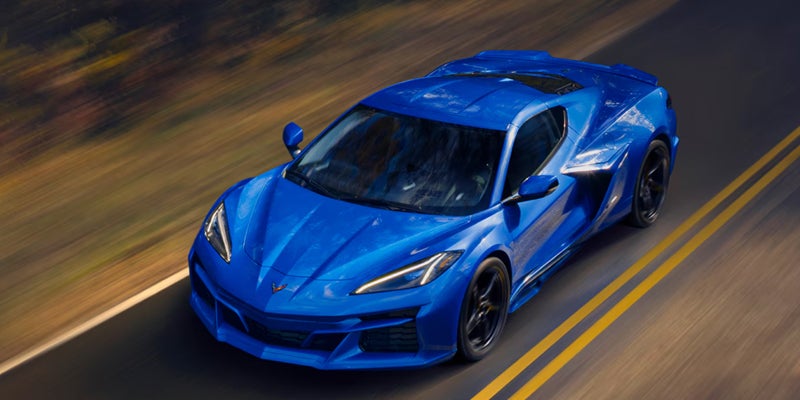
The new Corvette E-Ray sits in a part of the Corvette lineup that did not exist until recently, and shoppers who are just discovering it often have more questions than answers. It is not the highest-horsepower model in the family. It does not plug in. Yet it is the quickest Corvette to reach 60 mph that Chevrolet has ever produced. For buyers who have followed the Corvette for years, that combination raises legitimate questions about what the E-Ray actually is and where it belongs in a purchase decision. This blog addresses those questions directly, starting with the architecture that makes the E-Ray structurally unlike every Corvette that came before it.
What the E-Ray Actually Is
The Corvette E-Ray is the first electrified Corvette in the model's history, and that distinction carries more structural weight than it might initially suggest. Every Corvette before it has been a rear-wheel-drive vehicle, with power sent exclusively through the rear axle by the combustion engine. The E-Ray changes that in a specific and deliberate way: it keeps the rear-mounted 6.2-liter LT2 V8 in place while adding an independent electric motor at the front axle.
That front electric motor is not a range-extending unit and is not connected to an external charging port. It exists specifically to drive the front wheels, creating a vehicle that is all-wheel drive without altering the fundamental rear-drive identity that Corvette has maintained for decades. The V8 continues to power the rear wheels exactly as it does in the Stingray. What the electric motor adds is a second, independent power source at the front that can engage on its own terms, separate from what the combustion engine is doing at the rear.
The result is a car that feels like a Corvette in every way that has historically defined the nameplate, with an added layer of traction and launch authority that the rear-drive variants cannot access. Shoppers who have written off the E-Ray as a hybrid compromise tend to reconsider once they understand that the electric component was engineered to expand what the car can do, not to soften how it does it.
How the eAWD Setup Works
Chevrolet uses the term eAWD to describe the E-Ray's drivetrain, and understanding what that label means at a mechanical level is the clearest path to understanding what makes this Corvette different. The front electric motor draws from an 1.9 kWh battery pack mounted behind the seats. That battery is not large by EV or plug-in hybrid standards, and it was not designed to be. Its job is to store and deliver energy quickly in the moments when the front motor needs to act.
The front motor operates independently from the V8 at the rear. When the car's control systems determine that additional front-axle torque will improve traction or acceleration, the electric motor engages and delivers power to the front wheels. This happens in a time frame that mechanical systems cannot match. There is no driveshaft to spin up, no clutch pack to engage, and no hydraulic pressure to build. The torque arrives at the front wheels almost instantaneously from the moment the motor receives the signal to act.
In everyday use, the eAWD system operates largely in the background. The driver does not manually select when the front motor activates. The system reads wheel slip, throttle input, steering angle, and vehicle speed continuously and decides when front-axle torque is appropriate. On a dry road at moderate speeds, the rear V8 handles most of the work and the front motor stays quiet. At launch, in low-traction conditions, or during hard acceleration out of a corner, the front motor contributes meaningfully to what the car can do without the driver managing anything manually.
The battery recharges through two sources: regenerative braking, which captures energy during deceleration, and the V8 itself, which can direct excess power toward the battery when conditions allow. This is why the E-Ray does not require external charging. The system maintains its own energy state continuously during driving.
Is the Corvette E-Ray a Plug-In Hybrid?
No. The Corvette E-Ray is not a plug-in hybrid, and that distinction matters for anyone evaluating it alongside vehicles like the Porsche 918 or other electrified performance cars that do require charging infrastructure. The E-Ray has no charging port. There is no Level 1, Level 2, or DC fast-charge capability built into the car. Owners do not need a home charger, a garage outlet, or access to a charging network.
The classification that fits the E-Ray most accurately is a mild hybrid with a performance-focused electric drive axle. The battery is small enough to be recharged entirely through normal driving, and the electric motor's role is traction and acceleration rather than range or fuel economy. This is a meaningful structural difference from vehicles like the Toyota RAV4 Prime or the Ford Escape PHEV, where the battery is sized to allow electric-only driving for a set number of miles and external charging is part of the ownership routine.
Shoppers who assumed the E-Ray would require a lifestyle adjustment around charging will find that it does not. The car operates like a conventional vehicle from an ownership standpoint. Fill it with fuel and drive it. The electric system manages itself without driver input and without connection to an external power source. For buyers who want the performance advantages of electrification without the infrastructure commitment that plug-in vehicles require, that distinction puts the E-Ray in a different category than most electrified performance cars currently on the market.
Why the E-Ray Reaches 60 Faster Than Higher-Horsepower Corvettes
The Corvette E-Ray produces 655 horsepower combined, which is less than the Z06's 670 horsepower from its flat-plane 5.5-liter V8. Yet the E-Ray reaches 60 mph in 2.5 seconds, which is quicker than the Z06 manages from a standing start. Shoppers who notice this discrepancy are right to question it, and the explanation comes down to how and when torque reaches the wheels rather than how much peak power the engine produces.
At the moment of launch, the front electric motor delivers torque to the front wheels with essentially no delay. Electric motors reach their full torque output at zero RPM, which means the front axle is pulling the car forward from the instant the driver releases the brake. The rear V8 is doing the same at the rear. The car is being accelerated by two independent power sources simultaneously, one mechanical and one electrical, from the very first fraction of a second of forward motion.
The Z06, despite its higher peak horsepower, sends all of its power through the rear wheels. At launch, it must manage wheel spin and traction limits through the rear tires alone. The stability control and launch control systems help, but the physics of putting 670 horsepower through two rear contact patches creates a ceiling on how aggressively the car can accelerate from rest. The E-Ray has four driven wheels managing a combined 655 horsepower, and the front axle's instant torque delivery fills in the gap during the most traction-sensitive part of the acceleration run.
The following factors contribute to the E-Ray's 0-to-60 advantage over rear-drive Corvette variants:
- Electric motor torque is available at zero RPM with no buildup delay
- Four driven wheels distribute the combined power across more contact area at launch
- The front motor activates independently, so it does not wait for mechanical inputs from the drivetrain
- Traction limits at the rear are offset by simultaneous front-axle pull rather than managed by rear grip alone
Where the E-Ray Fits in the Corvette Lineup
The current Corvette family includes the Stingray, the E-Ray, and the Z06. Each represents a different answer to a different version of the same question: what do you want from a Corvette? The Stingray is the entry point, rear-wheel drive, powered by the 6.2-liter LT2 V8, and the most driver-adjustable of the three in terms of how it delivers its power and how it responds to input. It is the lightest version of the C8 platform and the most track-balanced for drivers who prefer a pure rear-drive setup.
The Z06 sits at the top of the combustion-only portion of the lineup. Its 5.5-liter flat-plane crank V8 is a different engine entirely from the LT2 in the Stingray and E-Ray, and it produces its power in a higher-revving, more aggressive way. The Z06 is the choice for drivers who want the highest output from a naturally aspirated engine and who are comfortable with a car that demands more from the driver at the limit.
The E-Ray occupies a specific middle position that is not simply a compromise between the other two. It uses the same LT2 V8 as the Stingray but adds the electric front axle, which changes the car's character in conditions where rear-drive traction is the limiting factor. Shoppers who live in climates with varied road conditions, who want a Corvette they can use more of the year, or who want the fastest point-to-point acceleration without the Z06's demand level at the limit will find that the E-Ray addresses a real gap in what the Corvette family offers.
For buyers at Stuteville Chevrolet who are working through the lineup decision, the most useful frame is this: the Stingray prioritizes driver engagement through rear-drive purity, the Z06 prioritizes peak combustion output, and the E-Ray prioritizes all-conditions performance through a drivetrain architecture that neither of the other two can replicate. All three are Corvettes. Each one is built around a different answer to what that means.